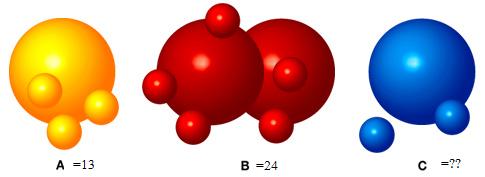
??Puzzzle??

Want to know the value of C...........A&B are known?
I've a solution but let that doesn't explain wht the smaller sphere is detached in the figure C...Looking for a logical explanation!!
Posted by sam at 4:25 AM 0 comments
smoking
Tuesday, February 21, 2006
Carbon monoxide (CO)
Irritants
Tars
Chemistry of Tobacco Smoke
hydrogen sulphide (gases); methyl alcohol, éthanol, glycerol or glycerine, glycol (alcohols and esters); acetaldehyde, acrolein, acetone (aldehydes and ketones); cyanhydric or prussic acid, carboxyl derivatives (acids); chrysene, pyrrolidine, nicoteine, nicotinine, nicoteline, nornicotine, nitrosamines (alkaloids or bases); cresol (phenols), etc.
Posted by sam at 4:36 AM 0 comments
Another Valentines Day !!!
Tuesday, February 14, 2006
By any other name would smell as sweet;
So Romeo would, were he not Romeo called. "
-- William Shakespeare
February 14 is Valentine's Day. Although it is celebrated as a lovers' holiday today, with the giving of candy, flowers, or other gifts between couples in love, it originated in 5th Century Rome as a tribute to St. Valentine, a Catholic bishop.
For eight hundred years prior to the establishment of Valentine's Day, the Romans had practiced a pagan celebration in mid-February commemorating young men's rite of passage to the god Lupercus. The celebration featured a lottery in which young men would draw the names of teenage girls from a box. The girl assigned to each young man in that manner would be his sexual companion during the remaining year.
In an effort to do away with the pagan festival, Pope Gelasius ordered a slight change in the lottery. Instead of the names of young women, the box would contain the names of saints. Both men and women were allowed to draw from the box, and the game was to emulate the ways of the saint they drew during the rest of the year. Needless to say, many of the young Roman men were not too pleased with the rule changes.
Claudius had determined that married men made poor soldiers. So he banned marriage from his empire. But Valentine would secretly marry young men that came to him. When Claudius found out about Valentine, he first tried to convert him to paganism. But Valentine reversed the strategy, trying instead to convert Claudius. When he failed, he was stoned and beheaded.
During the days that Valentine was imprisoned, he fell in love with the blind daughter of his jailer. His love for her, and his great faith, managed to miraculously heal her from her blindness before his death. Before he was taken to his death, he signed a farewell message to her, "From your Valentine." The phrase has been used on his day ever since.
Although the lottery for women had been banned by the church, the mid-February holiday in commemoration of St. Valentine was still used by Roman men to seek the affection of women. It became a tradition for the men to give the ones they admired handwritten messages of affection, containing Valentine's name.
The first Valentine card grew out of this practice. The first true Valentine card was sent in 1415 by Charles, duke of Orleans, to his wife. He was imprisoned in the Tower of London at the time.
Cupid, another symbol of the holiday, became associated with it because he was the son of Venus, the Roman god of love and beauty. Cupid often appears on Valentine cards.
Posted by sam at 4:07 AM 2 comments
COMPUTER TRICKS
☞ Shutdown XP Faster
1)Start - Run - Regedit
Navigate to the following Registry key:
HKEY CURRENT USER\Control Panel\Desktop
Double click on the AutoEndTasks entry and replace the 0 with a 1 in the Value data text box
For the next two, if the dword value indicated does not exist, create it:
Double click on the WaitToKillAppTimeout entry in the right pane and change the Value data to 2000
Double click on the HungAppTimeout entry in the right pane and change the Value data to 1000
Reboot
If still having a problem, make the next change:
2) HKEY_LOCAL_MACHINE\SYSTEM\CurrentControlSet\Contro l
Right-click on WaitToKillServiceTimeout and change it to 2000
NOTE: The lowest value Windows will recognize is 1000 (1 second)
ADVISORY: While rare, the "WaitToKillService" tweak can cause problems. If an application is in the process of saving data and the associated service is stopped prematurely, the data will not be saved and may be lost.
☞ Speed up Network Browsing
There was a bug in windows 2000 that would cause the scheduled tasks folder to be searched when ever the user would browse network drives. Microsoft developed a fix for this bug. The fix fixed the problem and it also had nice side affect of speeding up browsing of Microsoft networks. Below are instructions how to apply the fix.
1. Open up regedit.
2. Navigate to HKEY_LOCAL_MACHINE/Software/Microsoft/Windows/Current Version/Explorer/RemoteComputer/NameSpace.
3. Find a key named {D6277990-4C6A-11CF-8D87-00AA0060F5BF}.
4. Right click on it and delete it.
5. Restart
☞ Windows XP does have a back-up Utility!!!
Insert your windows XP disc into your PC. Click exit if your installation screen comes up. Now go too your CD drive in *My Computer*. Right-click and select open. Choose VALUE ADD\MSFT\NT BACK-UP FILE. In the *files of type* drop down list be sure that *select all files* is on. Click on the NTBACK-UP.msi file and click okay. Click the finish button and now go over too the start button\ALL PROGRAMS\ACCESSORIES\SYSTEM TOOLS\ and there it is now.. BACK-UP FILES...Great little tool that Microsoft never should have hidden
¥Change Browser Toolbar Background
This tweak customizes the appearance of the Internet Explorer Toolbar
XP Professional
1. Click Start > Run > Type gpedit.msc
2. Click User Configuration > Windows Setting > Internet Explorer Maintenance > Browser User Interface
3. Double click on Browser Toolbar Customization
4. Click on Customize Toolbar Background Bitmap
5. Browse for the new Background
XP Home Edition
1. Click Start > Run, type: regedit
2. Navigate to HKEY_CURRENT_USER\Software\Microsoft\Internet Explorer\Toolbar
3. Right click on an empty spot and create a new string value
4. Name it BackBitmapIE5
5. Doubleclick on BackBitmapIE5 and type in the path of your toolbar bitmap
6. Click OK and close regedit
(always backup before making any changes in the registry)
Note: Because you can customize your browser toolbar there isn't a specific size which
you need to make this tweak work. Play around with the size until you get it right.
-----
The Width of your toolbar with be the width of your resolution. 1024 will be your width
if your resolution is 1024x768.
☞ Change your Welcome (login) Screen
This tweak will only work if you have the "Use welcome screen" option activated in
Control Panel>Users Accounts>Logon and Logoff Options.
1. Make a backup copy of C:\windows\system32\logonui.exe
2. Overwrite the file with your new login screen. (be sure to use the same file name as the old logonui.exe)
3. If you ever want to revert back to the old login screen, just overwrite C:\windows\system32\logonui.exe with your backup.
Enjoy!
☞ Some edits and supplements
Windows System File Protection will not allow to override the file unless you follow these steps:
1. Rename the logonui.exe file in either C:\Windows\system32\dllcache or in C:\Windows\ServicePackFiles\i386
(depends on if and how you installed the servicepack).
2. Copy your custom logonui.exe to this folder.
3. Boot into safe mode and do exactly the same (rename the original file and copy in your new one) in C:\Windows\system32.
System File Protection will pop up two windows. Answer them with "cancel" and "yes".
Note: It is always better to rename the original file and not override it.
Alternatively you can use this method to change the Welcome screen :
1. Copy your custom logon file under another name, let's say logonuiA.exe, to C:\Windows\system32.
2. Open regedit (Always backup before changing anything in the registry) to
HKEY_LOCAL_MACHINE\SOFTWARE\Microsoft\Windows NT\CurrentVersion\Winlogon
and change the value for UIHost to logonuiA.exe.
☞ Increase your Bandwidth by 20%
Windows uses 20% of your bandwidth! Get it back
A nice little tweak for XP. M*crosoft reserves 20% of your available bandwidth for their own purposes (suspect for updates and interrogating your machine etc..)
Here's how to get it back:
Click Start-->Run-->type "gpedit.msc" without the "
This opens the group policy editor. Then go to:
Local Computer Policy-->Computer Configuration-->Administrative Templates-->Network-->QOS Packet Scheduler-->Limit Reservable Bandwidth
Double click on Limit Reservable bandwidth. It will say it is not configured, but the truth is under the 'Explain' tab :
"By default, the Packet Scheduler limits the system to 20 percent of the bandwidth of a connection, but you can use this setting to override the default."
So the trick is to ENABLE reservable bandwidth, then set it to ZERO. This will allow the system to reserve nothing, rather than the default 20%.
works on XP Pro, and 2000
other OS not tested.
its do-able only in xp pro.
Posted by sam at 3:53 AM 1 comments
23 ways to speed up xp
Tuesday, February 07, 2006
3.) Ensure that Windows XP is utilizing the NTFS file system. If you're not sure, here's how to check: First, double-click the My Computer icon, right-click on the C: Drive, then select Properties. Next, examine the File System type; if it says FAT32, then back-up any important data. Next, click Start, click Run, type CMD, and then click OK. At the prompt, type CONVERT C: /FS:NTFS and press the Enter key. This process may take a while; it's important that the computer be uninterrupted and virus-free. The file system used by the bootable drive will be either FAT32 or NTFS. I highly recommend NTFS for its superior security, reliability, and efficiency with larger disk drives.
4.) Disable file indexing. The indexing service extracts information from documents and other files on the hard drive and creates a "searchable keyword index." As you can imagine, this process can be quite taxing on any system.
The idea is that the user can search for a word, phrase, or property inside a document, should they have hundreds or thousands of documents and not know the file name of the document they want. Windows XP's built-in search functionality can still perform these kinds of searches without the Indexing service. It just takes longer. The OS has to open each file at the time of the request to help find what the user is looking for.
Most people never need this feature of search. Those who do are typically in a large corporate environment where thousands of documents are located on at least one server. But if you're a typical system builder, most of your clients are small and medium businesses. And if your clients have no need for this search feature, I recommend disabling it.
Here's how: First, double-click the My Computer icon. Next, right-click on the C: Drive, then select Properties. Uncheck "Allow Indexing Service to index this disk for fast file searching." Next, apply changes to "C: subfolders and files," and click OK. If a warning or error message appears (such as "Access is denied"), click the Ignore All button.
5.) Update the PC's video and motherboard chipset drivers. Also, update and configure the BIOS.
6.) Empty the Windows Prefetch folder every three months or so. Windows XP can "prefetch" portions of data and applications that are used frequently. This makes processes appear to load faster when called upon by the user. That's fine. But over time, the prefetch folder may become overloaded with references to files and applications no longer in use. When that happens, Windows XP is wasting time, and slowing system performance, by pre-loading them. Nothing critical is in this folder, and the entire contents are safe to delete.
7.) Once a month, run a disk cleanup. Here's how: Double-click the My Computer icon. Then right-click on the C: drive and select Properties. Click the Disk Cleanup button -- it's just to the right of the Capacity pie graph -- and delete all temporary files.
8.) In your Device Manager, double-click on the IDE ATA/ATAPI Controllers device, and ensure that DMA is enabled for each drive you have connected to the Primary and Secondary controller. Do this by double-clicking on Primary IDE Channel. Then click the Advanced Settings tab. Ensure the Transfer Mode is set to "DMA if available" for both Device 0 and Device 1. Then repeat this process with the Secondary IDE Channel.
9.) Upgrade the cabling. As hard-drive technology improves, the cabling requirements to achieve these performance boosts have become more stringent. Be sure to use 80-wire Ultra-133 cables on all of your IDE devices with the connectors properly assigned to the matching Master/Slave/Motherboard sockets. A single device must be at the end of the cable; connecting a single drive to the middle connector on a ribbon cable will cause signaling problems. With Ultra DMA hard drives, these signaling problems will prevent the drive from performing at its maximum potential. Also, because these cables inherently support "cable select," the location of each drive on the cable is important. For these reasons, the cable is designed so drive positioning is explicitly clear.
10.) Remove all spyware from the computer. Use free programs such as AdAware by Lavasoft or SpyBot Search & Destroy. Once these programs are installed, be sure to check for and download any updates before starting your search. Anything either program finds can be safely removed. Any free software that requires spyware to run will no longer function once the spyware portion has been removed; if your customer really wants the program even though it contains spyware, simply reinstall it.
11.) Remove any unnecessary programs and/or items from Windows Startup routine using the MSCONFIG utility. Here's how: First, click Start, click Run, type MSCONFIG, and click OK. Click the StartUp tab, then uncheck any items you don't want to start when Windows starts.
12.) Remove any unnecessary or unused programs from the Add/Remove Programs section of the Control Panel.
13.) Turn off any and all unnecessary animations, and disable active desktop. In fact, for optimal performance, turn off all animations. Windows XP offers many different settings in this area. Here's how to do it: First click on the System icon in the Control Panel. Next, click on the Advanced tab. Select the Settings button located under Performance. Feel free to play around with the options offered here, as nothing you can change will alter the reliability of the computer -- only its responsiveness.
14.) If your customer is an advanced user who is comfortable editing their registry, try some of the performance registry tweaks offered at Tweak XP.
15.) Visit Microsoft's Windows update site regularly, and download all updates labeled Critical. Download any optional updates at your discretion.
16.) Update anti-virus software on a weekly, even daily, basis. Make sure they have only one anti-virus software package installed. Mixing anti-virus software is a sure way to spell disaster for performance and reliability.
17.) Make sure you fewer than 500 type fonts installed on their computer. The more fonts they have, the slower the system will become. While Windows XP handles fonts much more efficiently than did the previous versions of Windows, too many fonts -- that is, anything over 500 -- will noticeably tax the system.
18.) Do not partition the hard drive. Windows XP's NTFS file system runs more efficiently on one large partition. The data is no safer on a separate partition, and a reformat is never necessary to reinstall an operating system. The same excuses people offer for using partitions apply to using a folder instead. For example, instead of putting all your data on the D: drive, put it in a folder called "D drive." You'll achieve the same organizational benefits that a separate partition offers, but without the degradation in system performance. Also, your free space won't be limited by the size of the partition; instead, it will be limited by the size of the entire hard drive. This means you won't need to resize any partitions, ever. That task can be time-consuming and also can result in lost data.
19.) Check the system's RAM to ensure it is operating properly. I recommend using a free program called MemTest86. The download will make a bootable CD or diskette (your choice), which will run 10 extensive tests on the PC's memory automatically after you boot to the disk you created. Allow all tests to run until at least three passes of the 10 tests are completed. If the program encounters any errors, turn off and unplug the computer, remove a stick of memory (assuming you have more than one), and run the test again. Remember, bad memory cannot be repaired, but only replaced.
20.) If the PC has a CD or DVD recorder, check the drive manufacturer's Web site for updated firmware. In some cases you'll be able to upgrade the recorder to a faster speed. Best of all, it's free.
21.) Disable unnecessary services. Windows XP loads a lot of services that your customer most likely does not need. To determine which services you can disable for your client, visit the Black Viper site for Windows XP configurations.
22.) If you're sick of a single Windows Explorer window crashing and then taking the rest of your OS down with it, then follow this tip: open My Computer, click on Tools, then Folder Options. Now click on the View tab. Scroll down to "Launch folder windows in a separate process," and enable this option. You'll have to reboot your machine for this option to take effect.
23.) At least once a year, open the computer's cases and blow out all the dust and debris. While you're in there, check that all the fans are turning properly. Also inspect the motherboard capacitors for bulging or leaks.
Following any of these suggestions should result in noticeable improvements to the performance and reliability of your customers' computers. If you still want to defrag a disk, remember that the main benefit will be to make your data more retrievable in the event of a crashed drive.
You may well want to read this article (http://www.globetechnology.com/serv...hnology/techBN/)
before you do that.
Do you really want to - i mean if it's running fine as is then i wouldn't worry too much about it.
I believe point #18 is mainly aimed at lower-spec Pc's
Posted by sam at 6:36 PM 0 comments
My favourite songs ..
Thursday, February 02, 2006
Hindi Song Title: Jiya Dhadak Dhadak Jaayen
Hindi Movie Name: KALYUG
Singer: RAHAT FATEH ALI KHAN
Hindi Lyrics:
tujhe dekh dekh sona
tujhe dekh kar hain jagna
maine yeh zindagani
sang tere bitaani
tujhmein basi hain meri jaan haai
jiya dhadak dhadak
jiya dhadak dhadak
jiya dhadak dhadak
jaayen jaayen
Hindi Song Title: My Dil Goes mmmmmm....
Hindi Movie Name: SALAAM NAMASTE
Singer(s): SHAAN, GAYATRI IYER
Hindi Lyrics:
aati hain woh aaise chal ke jaise jannat mein rehti hain
dekhti hain sabko aaise jaise sabko woh sehti hain
par gusse mein jo aaye aur ankhein woh dikhlaye
ladte ladte galti se muskaaye
my dil goes mmmmmm....
Hindi Song Title: Dil de diya hai...
Hindi Movie Name: MASTI
Singer: ANAND RAAJ ANAND
Hindi Lyrics:
Aa…aa…
Dil de diya hai, jaan tumhein denge
Aa..
Dil de diya hai, jaan tumhein denge
Daga nahin karenge sanam
Dil de diya hai, jaan tumhein denge
Daga nahin karenge sanam
Ho…rab di kasam yaara, rab di kasam
Dil de diya hai, jaan tumhein denge
Daga nahin karenge sanam
Dil de diya hai, jaan tumhein denge
Daga nahin karenge sanam
Posted by sam at 5:06 AM 0 comments